
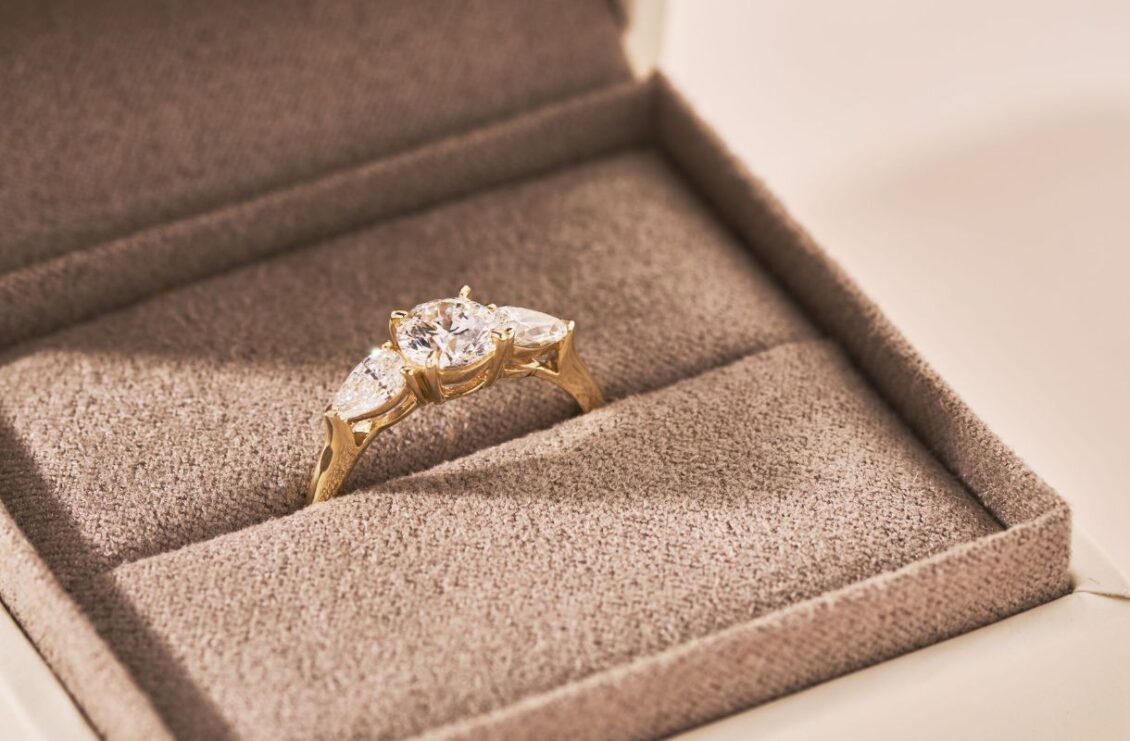
Gold is the same element wherever it is dug out of the ground. What separates one parcel of it from another is where it came from, how much of it there ever was, and what has been made from it since. On all three counts the gold taken out of one hillside in North Wales occupies a position that no amount of marketing could manufacture, because the facts were settled long before anyone thought to sell jewellery on the strength of them.
Clogau takes its name from that hillside. The Clogau St David’s mine sits at Bontddu, near Barmouth in Gwynedd, inside what is now Snowdonia, and for a stretch of the nineteenth century it was the most productive gold mine in Britain. The company that carries the name was founded in 1989, more than a century after the mine’s best years and nine years before it closed for the last time, and it exists in large part to keep a finite material in circulation rather than in a vault.
This piece deals first with the geology and the mining history, because the royal association makes very little sense without them. Only then does it turn to the 1911 investiture, to the run of royal wedding rings, and to precisely what the royal claim does and does not mean. That last distinction matters, and it is one that gets blurred more often than it should.
The Hillside at Bontddu
The gold at Bontddu is hard-rock gold, locked in stone and taken out by tunnelling rather than panned from a riverbed. That is the expensive way to get gold. It means shafts, timber, drainage, spoil heaps and a workforce, and it means that a seam has to be genuinely rich before the arithmetic works at all. Most Welsh gold workings never reached that point and were abandoned within a few seasons.
The mine at Bontddu did reach it. The site sits in the hills above the Mawddach estuary, a landscape that today reads as pure Snowdonia scenery and once carried the traffic of a working operation. Anyone who wants the full sequence of dates and workings can read Clogau’s account of the mine’s history, which sets out how the site was worked and how it eventually stopped.
The geography is worth holding on to, because it explains the scarcity better than any adjective. Welsh gold is not rare in the way a limited edition is rare. It is rare because there is one small, awkward, expensive place it ever came from in quantity, and that place is shut.
Fifty Years as Britain’s Richest Gold Mine
Between 1862 and 1911 the mine was the largest and richest gold mine in Britain, and across that period it produced nearly two and a half tonnes of gold. Set against a modern industrial operation that is a trivial figure. Set against every other gold mine these islands have ever had, it is the record.
What Fifty Productive Years Actually Bought
Two and a half tonnes sounds substantial until you consider what it has had to cover: every ring, every chain, every commission and every ceremonial object made from Welsh gold in the century and a half since. It was never a supply that could sustain an industry. It was enough to make a national material of it, and not much more.
By 1911 the richest ground had been worked through, and the mine’s great period was over. It reopened and closed repeatedly across the following decades without ever recovering that peak, which is the usual biography of a hard-rock mine once the best seam runs out.
1998, and Why Nothing Has Replaced It
The mine closed for the last time in 1998. There has been no commercial gold mining in Wales since, which means the total quantity of Welsh gold in existence is now fixed. Nothing is being added. Every gram that gets worked into a piece of jewellery comes from a pool that only ever shrinks.
That is why Welsh gold has historically commanded many times the price of standard gold. The premium is not a matter of the metal behaving differently, since it does not, but of there being a hard limit on the amount available and no prospect of that limit moving. Ordinary gold is a commodity with a price. Welsh gold is a finite stock with a queue.
It also explains why Welsh gold turns up as an accent rather than as the whole of a piece. Across the gold jewellery Clogau produces, the Welsh gold content is a deliberate touch within a larger design, which is the only responsible way to work a material that cannot be replaced.
The 1911 Investiture and the Regalia
The first of the great royal uses came in 1911, when Prince Edward was invested as Prince of Wales and the regalia made for the ceremony incorporated Welsh gold. The choice was an obvious one in context. An investiture at Caernarfon that used gold from anywhere else would have missed the point of the occasion entirely.
What is notable is the timing. Nineteen eleven was the year the mine’s great productive run ended, so the regalia was made at almost the exact moment the supply began to close. The ceremony marked the beginning of the royal association and the end of the mine’s best years in the same twelve months.
The Wedding Rings, and the Years They Mark
The association that most people know about is the wedding rings, and it runs across a full century. The Queen Mother’s ring in 1923 began it. Queen Elizabeth II’s followed in 1947, Princess Margaret’s in 1960, Princess Anne’s in 1973, and the ring made for Princess Diana in 1981.
More recently the same material was used for the rings of 2011 and 2018, for Prince William and Catherine and for Prince Harry and Meghan. A century separates the first from the most recent, which is long enough for the practice to stop being a preference and start being a habit that nobody has had cause to break.
Why the Rings Are One Chapter Rather Than the Whole Book
The wedding rings attract the attention because weddings are public and rings are photographed. They are not, however, the substance of the story. The substance is the hillside at Bontddu and the fact that it stopped producing, and the rings are simply the most visible thing that scarce material has been made into.
Read the other way round, they become more interesting still. Each ring drew on a supply already understood to be limited, which is a more considered choice than it appears when reported as wedding trivia.
What the Royal Claim Means, and What It Does Not
Clogau’s own phrasing is careful, and it repays reading closely: rare Welsh gold as used by some members of the British Royal Family for over 100 years. Every word in that sentence is doing a job. The claim is about a material and its history of use. It is not a claim about a company.
Clogau is not an official royal jeweller. It does not hold a Royal Warrant, and no living member of the Royal Family endorses it. What is true, and what is sufficient, is that the metal has a documented record of royal use going back more than a hundred years, and that the same rare material is still worked today. Anyone who tells you more than that has added something that is not there.
Being precise about this is not modesty for its own sake. A claim that is exactly true survives scrutiny indefinitely. An inflated one gets found out, and it takes the true part down with it.
What the Royal Clogau Collection Is
The Royal Clogau collection is the part of the range that addresses this history directly. The pieces draw on the motifs and the associations of the royal connection, and they are made with the same rare Welsh gold that gives the connection its meaning in the first place. It is the most explicit expression of the story in wearable form.
For anyone approaching it for the first time, a pendant is usually the easiest entry point, and Clogau’s necklace designs cover a wide spread of weights and styles. Rings ask more of a decision, since they need sizing and they tend to be bought for a reason, but the ring designs Clogau offers are where the royal thread is most directly echoed.
Small Quantities, Held Back on Purpose
Each piece contains a small quantity of rare Welsh gold rather than being made wholly from it, and this is the single most important thing to understand about how the company works. With a supply that is fixed and shrinking, using the material generously in a handful of pieces would exhaust it quickly and put it beyond nearly everybody. Using a little in many pieces keeps it available.
That approach also decides what the jewellery looks like. The Welsh gold appears as a rose-toned element within a design rather than as its entirety, which is why pieces across the full Clogau jewellery range read as designed objects that happen to carry something rare, rather than as lumps of a scarce material. Each piece is identified by the Welsh dragon stamp alongside the Clogau stamps.
Restraint here is a form of respect for the material. There is no more of it coming, and spending it slowly is the only way the story continues.
Conclusion: A Heritage That Is Worn, Not Kept
The strange thing about heritage materials is how often they end up somewhere nobody can see them. Objects of real historical interest get catalogued, insured and put behind glass. That is a reasonable fate for regalia and a poor one for a chain or a ring.
Welsh gold escapes that because it was always going into things meant to be used. The rings above were not made for display cases. They were made to be put on and kept on, through decades of ordinary life, and that is what happened to them.
Anyone buying a piece from Clogau is taking a small share of a supply that stopped being replenished in 1998 and putting it back into daily circulation. That is a better use of a finite thing than saving it. Heritage that gets worn stays alive in a way that heritage under glass never quite manages.


More Stories
10 Creative Weight Loss Hacks That Actually Work (Without Starving Yourself!)
The Science-Backed, Flavor-First Weight Loss Diet Plan
The Science-Backed Diet Trick That Drops Pounds While You Sleep